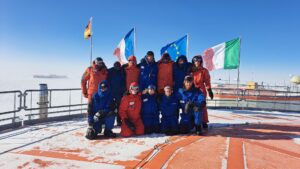
To mark the Italian Research Day in the World, and to highlight the excellence of Italian scientific work in Antarctica, the Embassy of Italy in Wellington has organised a video call with the team of Italian researchers currently stationed at Concordia Station.
We were also joined by Elena Campana, Director of the Antarctic Technical Unit at ENEA; Rocco Ascione, Head of Logistics and Operations (ENEA Antarctic Technical Unit); Riccardo Scipinotti (ENEA Antarctic Technical Unit); and our Honorary Consul in Christchurch, Belfiore Bologna, who has long provided valuable consular support to Antarctic missions.
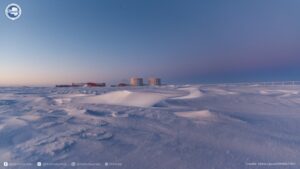
Concordia Station is the only Antarctic base jointly operated by two countries — Italy and France — through the Italian National Antarctic Research Programme (PNRA) and the French Polar Institute (IPEV). Operational since 2005, it stands at over 3,200 metres above sea level on the Antarctic Plateau, one of the most remote and extreme environments on Earth.
In addition to Concordia, Italy carries out significant scientific work in Antarctica also through the Mario Zucchelli Station, the Italian coastal base in Terra Nova Bay, and the Laura Bassi, an Italian icebreaker and research vessel operated by OGS. Both are active during the Antarctic summer season, conducting seasonal research activities, oceanographic missions and logistical operations in the Ross Sea and the Southern Ocean, often in collaboration with other international scientific programmes.
The Concordia Station is currently hosting the 22nd winter mission of the PNRA (#DC22). The so‑called “winterover” team (a group of researchers who remain on site throughout the Antarctic winter) will live in complete isolation for about nine months, facing three months of total darkness and temperatures that may drop to –80°C. They will remain at Concordia until October 2026, awaiting the last sunset that marks the beginning of the long Antarctic night.
During this period, the team will carry out 21 scientific activities across multiple disciplines. Among these are seven biomedicine projects coordinated by the European Space Agency (ESA), which investigate how extreme, space‑analog conditions affect the winterover crew: research that provides crucial insights for future long‑duration space missions.
We are proud to promote and support the work of Italian scientists who contribute to advancing global scientific knowledge from one of the most challenging environments on the planet. Our sincere thanks go to the Enea and Concordia team for their availability and extraordinary commitment, and to Antarctica New Zealand for its invaluable support to the success of the Italian mission.
Italian research continues to excel, even at the edge of the world.